


How can we minimise food’s exposure to oxygen, preserve its quality for longer and prepare products for safe storage and distribution? One of the solutions used in the food industry is vacuum packing. This technology is used both in the catering industry and in professional production facilities, where consistency, efficiency and the ability to integrate the packaging process into a larger production line are key.
In industrial settings, however, simply removing the air from the packaging is only part of the process. The following factors are also important: the type of packaging material, the quality of the seal, the temperature of the product, how it is prepared, storage conditions and appropriately selected equipment. Vacuum packaging should therefore be viewed as part of the overall production process, rather than simply as a single operation carried out by a sealing machine.
What is vacuum packing?
Vacuum packaging involves removing a significant amount of air from inside the packaging and then sealing it airtight. This reduces the amount of oxygen in the immediate vicinity of the product.
This is particularly important in the case of food, as oxygen plays a part in many processes that lead to a deterioration in product quality. Among other things, it can accelerate oxidation of fats, discolouration, drying out or loss of some sensory characteristics.
Restricting air access can therefore help to preserve the freshness, aroma, flavour and texture of the product for longer. Vacuum packaging is not, however, a method of sterilisation and does not eliminate all microorganisms. In the case of perishable products, the correct temperature, process hygiene, use-by date and maintenance of the cold chain remain extremely important.
How does the vacuum-packing process work?
The exact process depends on the technology used and the type of equipment. Put simply, the product is placed in suitable packaging, from which the air is then removed. The next stage is sealing the packaging securely by heat-sealing it.
In professional applications, the repeatability of the entire process is crucial. Each package should be produced in accordance with the specified parameters, and the quality of the seal must meet the requirements of the specific product and packaging material.
At the production plant, the following factors, amongst others, are taken into account cycle time, vacuum level achieved, product dimensions, film type, sealing temperature, product feeding method and the ability to integrate the machine with other components of the production line.
This is because packaging does not operate in isolation from the other stages of production. In many plants, it is preceded by portioning or product packaging, and once the individual packaging has been completed, the product can then be sent for inspection, labelling or bulk packaging.
Which products can be vacuum-packed?
Vacuum packaging is particularly often associated with the meat industry. The technology is used, amongst other things, for packaging meat, cold cuts, sausages and selected meat products. However, its uses do not end there.
Depending on the technology, product characteristics and process conditions, vacuum packaging can also be used for fish, cheese, delicatessen products, ready-to-eat portions, certain semi-finished products and products intended for subsequent freezing.
However, it is crucial to adapt the technology to the specific product. A compact cured meat will have different requirements to a product containing a large amount of liquid, and yet different requirements to a foodstuff with a delicate texture that may become misshapen under vacuum.
Therefore, in industrial applications, there is no single universal solution suitable for every type of food.
What are the benefits of vacuum packaging in a production facility?
One of the most important benefits is the ability to limiting the product’s exposure to oxygen, which may slow down some of the processes that contribute to a deterioration in its quality. This is important in terms of both the product’s shelf life and its appearance and sensory characteristics.
Vacuum packing can also help to protect the product from drying out and losing its flavour. Properly prepared packaging also makes it easier to food storage, portioning, transport and distribution.
From a business perspective, standardisation is also important. Automating or partially automating the process enables the production of packaging with consistent specifications, which facilitates the subsequent stages of production.
On a large scale, it is not only the packaging itself that is important, but the capacity of the entire production line. The equipment should therefore be in line with the actual production rate and be able to operate in conjunction with the machines upstream and downstream of it.
Vacuum packing versus airtight packing – are they the same thing?
These terms are sometimes used interchangeably, but they do not mean exactly the same thing.
Airtight packaging First and foremost, it is hermetically sealed and isolated from the outside environment. Vacuum packaging, on the other hand, also involves the prior removal of a significant proportion of the air inside the packaging.
Yet another technology is modified atmosphere packaging, or MAP. In this case, the air inside the packaging is replaced with a carefully selected gas mixture. Its composition is chosen to suit the characteristics of the packaged product, as well as its expected shelf life and method of distribution.
This does not, therefore, mean that a vacuum is always the best solution. The choice of technology should be based on the product’s characteristics and the purpose of the packaging process.
Tarpak’s range includes, amongst other things, a machine Atmosphere designed for creating airtight packaging in a modified atmosphere. This is an example of a solution that can serve as an alternative to traditional vacuum packaging in certain production processes.
Vacuum packers versus heat sealers – how do these machines differ?
Although the terms „packaging machine” and „sealing machine” are sometimes used interchangeably, these machines can perform a different range of operations.
The sealing machine is primarily responsible for creating a leak-proof seal in the packaging material. The sealing function itself does not, therefore, necessarily involve removing air from the packaging.
A vacuum sealer is a more complex solution, as the process involves both creating the right conditions inside the packaging and then sealing it.
In industrial plants, however, what matters most is the selection of a comprehensive technological solution. For this reason, when analysing packaging machines, it is worth considering not just the name or a single function of the machine, but the entire process that the machine is intended to handle.
How do you choose a packaging machine for a specific process?
It is not possible to identify a single „best vacuum sealer” for every business. A machine suitable for small-scale production may be completely inadequate for a facility operating on a multi-shift basis.
The first criterion should be product type. Its dimensions, mass, consistency, susceptibility to deformation or the presence of liquids may affect the suitability of a particular technology.
Another consideration is capacity. It is necessary to determine how many products are to be packaged per minute or per hour, and whether the machine will operate independently or as part of an automated production line.
Other important factors include packaging materials, the method of feeding them into the machine, the machine’s cleanability, the availability of spare parts, integration with control systems, and after-sales service.
In practice The selection of a machine should begin with an analysis of the production process, rather than simply comparing the devices’ specifications.
How long can vacuum-packed products be stored for?
There is no single, universal answer that determines the shelf life of every vacuum-packed food product.
The storage period depends, amongst other things, on the type of product, its microbiological condition prior to packaging, temperature, packaging properties, seal quality, vacuum level and the conditions of the entire production process.
It should therefore not be assumed that the use of a vacuum automatically extends the product’s safe storage life many times over.
In the case of industrial production, the use-by date should be determined on the basis of the product’s manufacturing process, quality procedures and relevant tests.
Does vacuum-packed food have to be kept in the fridge?
If a particular product requires refrigerated storage, simply using a vacuum can’t stand this requirement.
This applies, amongst other things, to many types of meat, cold meats, fish and ready meals. Vacuum packaging limits the supply of oxygen, but does not eliminate all microorganisms or biological processes that could lead to the product going off.
Therefore, such products should be kept at the correct temperature throughout the entire storage and transport period. Particularly in industrial production, a vacuum must be treated as one of the components of the food safety system, rather than a substitute for proper cooling.
What should not be vacuum-packed without proper preparation?
Not every product is suitable for simple vacuum packaging without a prior technical assessment.
Problems may include, amongst other things, very delicate products which become deformed under negative pressure, as well as foodstuffs whose microbiological properties require specific control of temperature, pH, water activity or shelf life.
That is precisely why, in professional production, the choice of packaging method should take into account not only the appearance of the packaging and the expected shelf life, but also the safety of the product.
From individual packaging to a complete production line
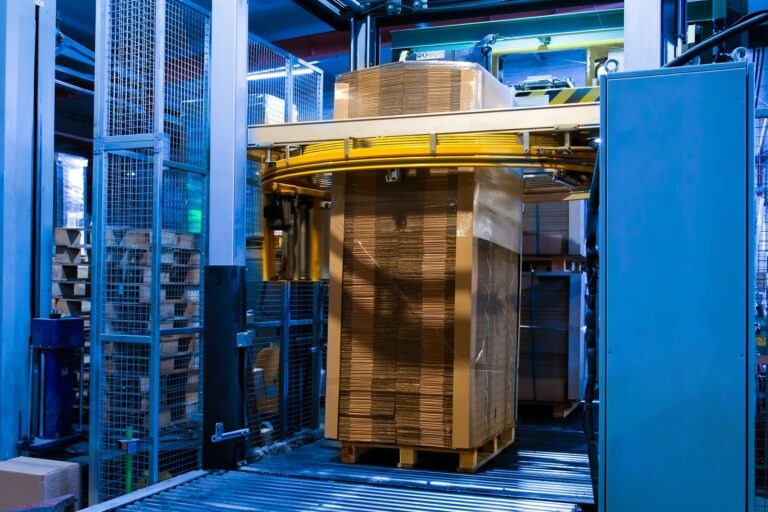
In a modern factory, vacuum packaging is rarely a completely independent process. The product must first be prepared, fed into the machine correctly, packaged, inspected and, often, labelled and placed in a master carton.
That is why, when designing a process, it is worth taking a holistic view of it.
Once the individual packaging has been produced, the next stage might, for example, involve packing the products into cartons. In such applications, the following are used cartoners, which enable the next stage of the process to be automated and products to be prepared for storage or transport.
This approach helps to reduce the number of manual operations and to better synchronise the various stages of production.
Packaging as an element of production automation
In manufacturing companies, the focus is increasingly shifting away from seeking a single machine, but rather solutions tailored to a specific technological process.
The packaging technology should be suited to the type of product, the planned output, the packaging format, the plant conditions and the subsequent stages of production. In some cases, vacuum packaging will be the optimal choice; in others, modified atmosphere packaging, hermetic packaging or another technology may be more suitable.
Tarpak designs and manufactures machinery and solutions for the automation of packaging processes. This collaboration may include the selection and configuration of equipment, its installation and commissioning, staff training, and subsequent technical support.
This allows the packaging process to be analysed in greater detail — from individual products and packaging right through to an automated production line tailored to the needs of a specific manufacturing plant.





 English (UK)
 Polski
 Deutsch